Linear Bearing or Linear Guide
Two architectures move things in straight lines: a bushing sliding on a round shaft, or a block running on a profiled rail. The choice is structural, not cosmetic.
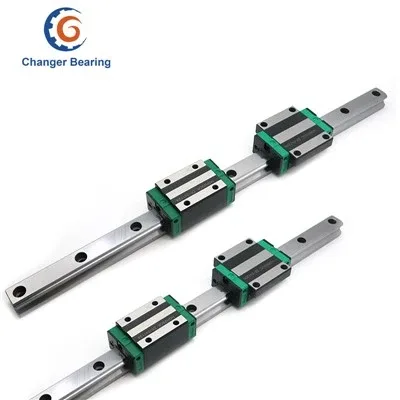
Two architectures, one job
Straight-line motion has two standard mechanical answers in this range. The linear ball bushing — the LM series and its flanged and housed relatives — runs on a round shaft, the shaft supported at its ends or along its length. The linear guide block — the HGH and HGW series — runs on a profiled rail bolted to the machine bed, the block's recirculating balls rolling on the rail's faces. Both families stand in this range, and the sorting is engineering, not steering, because the two systems are bought against different drawings and fail in different ways.
Load and moment: where the rail wins
A bushing on a shaft carries radial load well but resists twisting moment poorly — the shaft itself flexes, and a single bushing on a single shaft lets the load rotate. The standard answers are twin shafts, spaced bushings, or accepting the rotation. A rail block carries load in all directions including moment, because the rail is a beam bolted down along its length and the block wraps its faces. Cantilevered loads, offset centres of gravity and cutting forces are rail territory; centred, balanced, light loads are bushing territory. If the drawing shows the load hanging off the side of the motion, the guide block is usually the honest answer.
Stiffness and accuracy follow the support
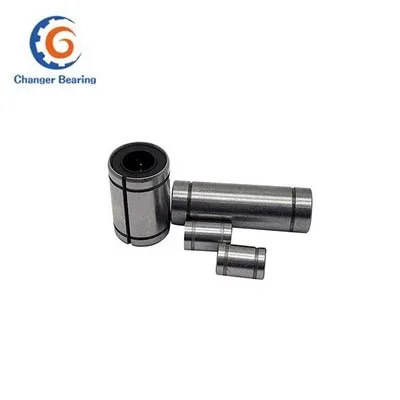
A shaft is only as straight and stiff as its supports: an end-supported shaft sags between its mounts under load, and the bushing faithfully follows the sag. A rail is supported continuously by the bed it is bolted to, so its straightness is the machining of the bed and the rail together. That is why machine tools, cutting gantries and precision stages are rail machines, while printers, small dispensers, light packaging axes and countless small mechanisms run happily on shafts for decades. Both stand in the linear family, and the LM8UU — positioned for 3D printers — marks the bushing's home ground accurately.
| Point | Bushing on a shaft (LM) | Block on a rail (HGH, HGW) |
|---|---|---|
| Moment load | Poor alone; needs twin shafts | Carried by the block and rail |
| Support | Shaft ends or shaft supports | Rail bolted along the bed |
| Best ground | Light, centred, cost-led axes | Machine axes, cutting, precision stages |
| Bought as | Bushings per shaft, shafts, supports | Blocks per rail, rails per axis |
Cost and complexity follow the architecture
The bushing system is cheaper and simpler at every step: round shafts are commodity parts, bushings press into simple bores, alignment is forgiving, and a worn bushing is a small part swapped in minutes. The rail system costs more in parts and in machining — the bed must be flat, the rails aligned, the blocks counted per axis — and returns stiffness, capacity and life. Neither is the economy version of the other; they are different structures. The false economy in this family is almost always a bushing system asked to do a rail's moment work, not a rail system bought for a light axis.
Mixed machines are normal
Real machines mix the two without embarrassment: rail guides on the cutting axes where forces work, bushings on the auxiliary axes — a door, a sensor traverse, a light feed — where the load is centred and kind. The order for such a machine lists the two architectures separately, each with its own counting: blocks per rail and rails per axis on the guide side, bushings per shaft and shaft counts on the bushing side, with flanged bushings where a plate mounting serves better than a bore. One inquiry can carry both; one list line should never try to.
Replacement orders: matching what is installed
New designs get to choose their architecture; replacement orders inherit one. A machine built on round shafts needs bushings that fit those shafts, and no argument about guide rigidity changes the shaft already in the frame. The replacement discipline is therefore identification before preference: measure the shaft, read the bushing or the block as it stands, and order the same architecture in the same size. The one legitimate change on a replacement order is within the architecture — a sealed variant where the open one collected dirt, a different bushing length where the travel allows it — not a jump between architectures that the machine cannot accept.
The mixed case is the rebuild, where a machine is opened up far enough that its axes can be re-decided. There the drawing rule applies with full force, and the deciding evidence is the same as on a new design: rail space in the frame, the stiffness the cut demands, the environment the axis will live in. A rebuild that re-decides one axis and replaces the others like for like is a normal programme, and the inquiry should say which axes are which, so the two kinds of line are answered in their two different ways.
Whichever architecture an axis keeps, its wear parts belong on the standing list with their sizes recorded, because linear components are replaced more often than the machines they serve. A bushing size and a block series noted once, accurately, turn every later replacement into a quantities-only order — and spare the buyer the worst version of the job, measuring a worn component under time pressure with the machine already apart.
Keep the shaft or rail size with the entry as well: the component code alone does not record what it runs on, and the running surface is the half of the pair that survives to be measured wrongly later.
Dirt, washdown and the open shaft
Environment argues in both directions. An open shaft in a dusty plant collects abrasive paste along its whole travel, and a bushing wipes that paste into itself as it runs; a rail concentrates the same problem at the block's seals, where wipers can be specified and replaced. Wet duties corrode an unprotected shaft quickly, while a rail bolted to a bed traps water at its mounting face. Neither architecture is the clean one by nature — the question is which contamination path the machine can manage, and that answer belongs in the inquiry next to the architecture choice.
Deciding from the drawing
Ask the drawing four questions. Is the load offset or cantilevered? Does the axis take cutting or process force? How straight must the travel stay under load? And what does the bed offer — bores, plates or a machined rail seat? Offset load, process force, tight straightness and a machined bed point to the rail. Centred load, light force, ordinary accuracy and simple plates point to the shaft. If the answers split, the axis that carries the process gets the rail and the rest get bushings — and the inquiry lists them that way.
Send an inquiry
Decide each axis on its own — bushing or block — and send both lists with their counts and the destination market through the inquiry form.