Ceramic or Hybrid Ceramic Bearings
The difference between the two ceramic constructions is where the steel survives — and the choosing happens position by position, not by fashion.
The one-sentence difference
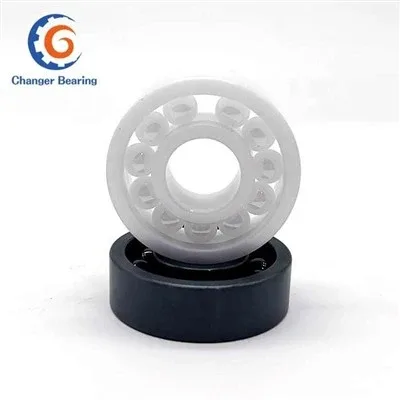
A hybrid ceramic bearing runs ceramic balls inside steel or stainless rings; a full ceramic bearing runs ceramic balls inside ceramic rings. Everything else — the price step, the corrosion reach, the insulation, the handling care — follows from that single fact about the rings. The ceramic family runs both constructions in silicon nitride Si3N4 and zirconia ZrO2, and they stand against plain steel in one table on the comparison page. The choosing happens per position, not per machine.
What ceramic balls alone buy
The balls are where a bearing works hardest, so changing only the balls buys a surprising amount: lower friction and heat at the contact, higher speed capability, longer contact life, and electrical insulation across the rolling path, which is why electric motors and generators headline the hybrid's territory — current that tracks through steel balls pits them, and ceramic balls break that circuit. If the position's problem lives at the contact — speed, wear, tracking, heat — the hybrid buys the answer and keeps steel rings, steel fits and a steel price structure around it.
What ceramic rings add
Rings change the answer where the environment reaches the whole bearing. A ceramic ring does not corrode in the chemicals that stain stainless, does not conduct at all rather than only across the contact, and is non-magnetic in a way no steel ring can be. Chemical and corrosive environments, semiconductor and clean equipment, and medical and laboratory positions — the family's core application areas — are ring problems as much as ball problems, and they are where the full ceramic build stops being a luxury and becomes the only construction in the set that answers.
What full ceramic costs beyond price
Ceramic is hard and brittle where steel is hard and forgiving, and the full ceramic build imports that character into the whole bearing: seating, handling and shock all need more care, and a housing that has happily taken steel bearings may need its fit re-thought for ceramic rings. None of this disqualifies the construction — the duties it serves are real — but it means full ceramic should be specified where its reach is needed, not as a general upgrade. A hybrid in a shock-loaded, roughly handled position will usually outlive a full ceramic bearing that was specified for prestige.
| Position pressure | Construction that answers | Why |
|---|---|---|
| Speed, heat, contact wear | Hybrid ceramic | The balls carry the problem |
| Electrical tracking through the bearing | Hybrid ceramic | Ceramic balls break the circuit |
| Chemical attack on all surfaces | Full ceramic | The rings face it too |
| Full insulation or non-magnetic build | Full ceramic | No steel anywhere in the bearing |
| Shock, rough handling, ordinary duty | Steel, from the main family | Forgiving material, lowest cost |
The two ceramic materials
Within either construction, the ceramic itself divides: Si3N4 silicon nitride is the harder, lighter, more thermally capable ceramic, the usual choice for balls and for demanding full builds; ZrO2 zirconia is the tougher, more forgiving ceramic, common in full ceramic bearings and in the loose bearing balls line, where the span runs 1 to 12 mm. The choice follows the same discipline as the construction choice — name the pressure first (heat and speed toward nitride, toughness and general corrosion toward zirconia), then the material word goes into the order line.
A worked way through a machine
Take a small chemical dosing pump skid. The motor positions run hot and fast with a drive that tracks current: hybrid. The pump-end positions sit in the chemical splash zone and are hosed down: full ceramic, because the rings are in the splash too. The idler and tensioner positions are ordinary dry steel work, and ordering them in ceramic would buy nothing. One machine, three constructions, each earning its place — that is the normal shape of a ceramic order, and the inquiry should read that way, position by position, rather than as a single construction declared for the whole list.
Counting the cost per position
Ceramic decisions stall on price because the comparison is usually made bearing against bearing, when the honest comparison is position against position. A hybrid bearing in a washdown pump costs more than the steel bearing it replaces and less than one unplanned stoppage of the line it serves; a full ceramic bearing in a chemical position costs more again and removes a failure mode entirely. The costing question is never “how much more is the ceramic bearing” but “what does this position cost when the steel bearing fails in it” — and in the duties where ceramic is specified, that second figure is the larger one by an order of magnitude.
The counting also runs the other way. A plant that converts every position to hybrid on the strength of one good washdown result pays the premium in hundreds of positions that will never see water. The disciplined programme converts the positions whose duty demands it, records which construction sits in which position, and leaves the dry general-purpose positions on steel, where steel is not a compromise but the correct engineering answer.
That record matters more than it looks. A hybrid and a full ceramic bearing of the same size are indistinguishable on a stores shelf to anyone who does not read the marking, and a fitter reaching for a spare at night will fit whichever comes to hand. Positions converted to ceramic should be recorded where the spares are recorded, with the construction named, so the bearing that goes back into a chemical position is a ceramic one and not the steel spare that happened to be in the bin.
Cages: the third material decision
One part of a ceramic bearing is neither ring nor ball: the cage that spaces the rolling elements. Cages in the ceramic constructions run in steel, polymer or ceramic, and the choice follows the same pressures as the construction itself. A steel cage inside a hybrid bearing is unremarkable; inside a full ceramic bearing ordered for full insulation or for a non-magnetic build, a steel cage quietly reintroduces the metal the order was placed to remove. Polymer cages suit clean and chemical duties and are the usual choice there. Where the reason for ceramic is a property of the whole bearing, name the cage material in the order line as well.
Writing ceramic into an inquiry
Per item: the size or the code it converts from, the construction (hybrid or full), the ceramic material, and the pressure in a few words. The pressure line is not decoration — it is what stops a later reader from value-engineering a full ceramic position down to a hybrid because the sizes match, and it is what lets the supplier flag a position where the chosen construction does not match the stated duty. Ceramic is the most reasoned purchase in the bearing range; the reasons belong on the order.
Send an inquiry
Work your list position by position — construction, material and pressure per item — and send it with quantities and the destination market through the inquiry form.