Reading Pillow Block Bearing Codes
Mounted unit codes look like alphabet soup until the system shows: UC names the insert, the letters after it name the housing, and the number names the size.
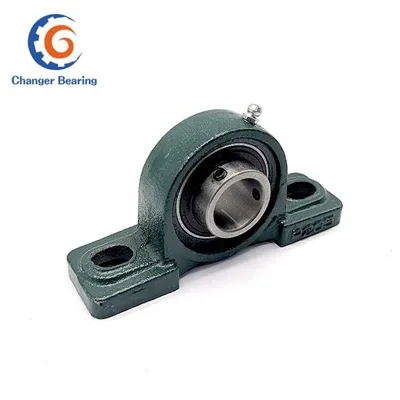
Reading a pillow block code
Start with the anatomy of one code: UCP206, the standard example of the pillow block line. It reads in three parts. UC is the insert — the bearing unit that locks to the shaft, common across the whole mounted family. P is the housing — in this case the pillow block casting that stands the shaft above a base. 206 is the size step, the number the shaft diameter hangs from inside the series. Every mounted code in the range follows the same grammar: insert, housing letter or letters, size number. Once the grammar is visible, the rest of the family stops being soup.
The housing letters
The housing letters are the code's working part. P alone is the pillow block. F is the four-bolt square flange, FL the two-bolt oval flange, FB the three-bolt flange, T the take-up unit that slides in a frame for tensioning, and PA the light-duty compact form. The letters are not decoration and they are not interchangeable: UCF, UCFL and UCFB are three different castings against the same shaft, and a copied list that loses the L in UCFL has silently reordered a different housing. The three flange patterns stand side by side with the flange units.
| Code | Housing | Mounts |
|---|---|---|
| UCP | Pillow block | Down to a base, shaft raised |
| UCF | Square flange | Flat to a frame, four bolts |
| UCFL | Oval flange | Flat to a frame, two bolts |
| UCFB | Three-bolt flange | Flat to a frame, three bolts |
| UCT | Take-up unit | In a sliding frame, for tensioning |
| UCPA | Light-duty unit | Compact housing, light duty |
The size number and the shaft
The number after the letters steps with the shaft size inside the series: as the number climbs, the bore climbs with it, in the series' own steps. The practical rule for a buyer is simpler than the table behind it — never order a mounted unit by the number alone from memory. The shaft diameter is the dimension the unit is bought against, and it belongs in the inquiry in plain figures next to the code, because a code copied with one digit wrong still looks like a code, while a shaft size written next to it exposes the error immediately.
The inch suffix: reading 205-16
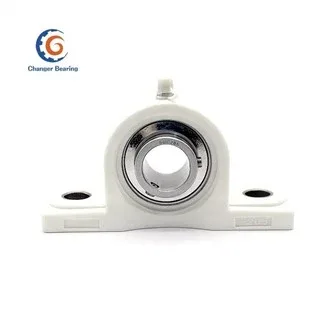
The mounted range also runs an inch line, and its codes say so: UCP205-16, UCF205-16, UCPA205-16, UCT205-16, UCFB205-16 and UCFL205-16 form the one-inch plastic set for the food industry. The -16 after the size is the inch marker — the bore is one inch, expressed in sixteenths in the convention of the system. A metric list and an inch list can share every other character and still be different units, which is why the suffix should be copied with the same care as the housing letters, and the shaft size stated in the inquiry in its own unit.
The S prefix: stainless codes
Stainless mounted units add one letter at the front: SUCP, SUCF and SUCT are the stainless forms of the pillow block, flange and take-up units, with stainless housings and inserts for washdown duties — see the stainless mounted units. The S is the easiest letter on the list to drop in a spreadsheet and the most expensive to lose, because the cast iron unit that arrives instead will fit perfectly and corrode on schedule. Read the prefixes back against the machine's wet and dry zones when you copy a list.
Clearance and insert notes
Two further points ride along with mounted codes in this range. The insert's internal clearance is an orderable point — the UCP206 example runs C0, C2 or C3 — and it belongs in the inquiry where the duty fixes it, since it does not appear in the short code. And the UC insert itself is shared across housings, so a position can change housing without changing the insert logic; a buyer re-casting a pillow block position as a flange position keeps the size number and changes the housing letters, which is the correct way to write that conversion.
When the code on the housing is not from this range
Most mounted lists do not start life as our codes. They start as the codes cast into housings already in service, written by makers whose letter systems differ from ours in detail. The reading method still applies — insert first, housing second, size third — because the architecture of a mounted code is shared across makers even where the letters are not. What changes is the conversion step: a foreign code is not re-lettered by guesswork but matched on its facts, the shaft size, the housing form and the bolt pattern, against the units in this range.
Sending the original code as written, rather than a home-made conversion, is what makes that matching reliable. A converted code hides the evidence; the original code, even from an unfamiliar maker, carries the size and the housing form in a notation our desk reads daily. Add a photograph of the housing where the code is unclear, and between the code and the photograph the unit is identified with certainty rather than probability.
One more habit protects the conversion permanently: once a foreign code has been matched to a unit in this range, record the pair together in the machine file, both codes side by side. The matching work is then done once, and every later order can be written in either notation with the answer already known. Buyers who keep that pairs list find their mounted orders become the fastest on their desk, because nothing on them needs interpreting twice.
Centre height: the dimension behind the pillow block
One dimension decides whether a replacement pillow block drops onto an existing line or fights it: the centre height, the distance from the base face to the shaft centre. Units of the same code share it, which is why code-for-code replacement is safe; units converted from another maker's system may carry the same bore in a taller or shorter casting. Where a line of blocks shares one shaft, a single unit at a different centre height tilts the shaft at that position. State the centre height beside the code on any conversion order, and the check happens before the casting arrives rather than at the fitting.
Copying a mounted list without breaking it
Mounted lists break in copying more than any other bearing list, because every character carries information and none of them look wrong when altered. The habits that protect them: copy codes whole, never retype from memory; state the shaft size next to each code in figures; keep stainless and cast iron positions on separate lines even at the same code; and name the housing in words once per group — pillow blocks, flange units — so a dropped letter shows against the word. Keep the copying clean, and the comparison guide only has to settle the genuine choices.
Send an inquiry
Copy your mounted codes whole, add the shaft size beside each, and send the list with quantities and the destination market through the inquiry form.